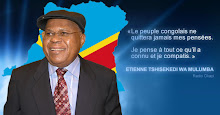
About Me

My photo
J'étais né à Kananga en 1932 et suis un homme politique de la République démocratique du Congo (RDC), ancien premier ministre du Zaïre (ancien nom de la RDC) et président de l'Union pour la démocratie et le progrès social (UDPS). J'avais obtenu mon diplôme de docteur en droit à l'université Lovanium de Kinshasa en 1961, devenant ainsi le premier diplômé en Droit du Congo. Entre 1961 et 1965, j'étais le recteur de l'École nationale de droit et d'administration (ENDA). En 1965, j'étais devenu ministre de l'intérieur et des affaires coutumières. En 1982, je participais à la fondation de l'UDPS. J'accèderai une première fois au poste de premier ministre entre le 29 septembre et le 1er novembre 1991. Lors du forum national, j'étais élu premier ministre le 15 août 1992. ENGLISH VERSION: I was born on 14 December 1932 and I am a Congolese politician and the National President of the Union for Democracy and Social Progress (UDPS), a political party in the Democratic Republic of the Congo. I was Prime Minister of the country (then Zaire) on three occasions during the 1990s: in 1991, 1992–1993, and 1997.

Tuesday, 23 November 2010

UN SEMBLANT D’ETAT EN ETAT DE RUINE


UN SEMBLANT D’ETAT EN ETAT DE RUINE
By Kris BERWOUTS, Director EurAc

Introduction: a growing democratic deficit


The Third Republic’s democratic deficit deteriorated and is a cause of great concern: democratic institutions are in hock to the government, which leads to decisions being taken through parallel channels; parliamentary debate is compromised by the increasing weakness of the opposition. Discussion on the revision of the constitution gives reason to fear that the current regime which came out of the electoral process of 2006 will simply perpetuate existing power balances.

We observe that the judiciary has difficulty in fulfilling its mission and note with consternation that its failures occasionally lead to “mob justice”. We are also aware that the people are disappointed with governance: the lack of real progress in the battle against corrupt practices in the administration goes together with a total refusal of any form of budget.

  1. The obsession with 2011: nearing the end of the first legislature

On 25 March, 2009, following two months of pressure from his party and President Kabila, Vital Kamerhe, the president of the Congo National Assembly, resigned his office. His political associates wanted him to leave because he had forcefully objected to Rwandese troops entering the country at the end of January.

The event mirrors several tendencies in Congolese political life:

a)      It was foreseeable that after the Congo elections in 2006 there would be tensions between the semi-presidential regime as defined by the Constitution and the Head of State, who felt that the elections legitimised his wish to set up a fully presidential regime. While Vital Kamerhe was in the chair, the National Assembly had faith in its role: it had claimed and obtained freedom to act as a legislative power and as a body of which the executive had to take account. Kamerhe’s departure diminished the autonomy of the Parliament.

b)      With the departure of Kamerhe the democratic deficit considerably increased. From that moment we can observe an increase in the number of cases of intimidation, arbitrary arrest and other violations of human rights affecting journalists, civil society leaders and politicians.

c)      Vital Kamerhe’s resignation also sparked off the election fever almost half way through the first legislative session of the Third Republic, the start of jockeying for position for 2011 and even for 2016. Insiders of Congolese politics told me that there was a deal between the Head of State and his stablemate who headed the National Assembly: Kamerhe would support the re-election of the current President in 2011 who would support, after his second and final term, the election of  Kamerhe as his successor in 2016. But Kamerhe’s visibility and popularity President of the Parliament has worrying the President (Kamerhe was becoming an independent political force too fast) as well as worrying his closest allies (especially Katumba Mwanke and Evariste Boshab would prefer not to leave the leadership of the country to Kamerhe in 2016).

d)      Finally, the offensive against Kamerhe is part of a process of closing the ranks around Kabila. The President is known as someone who finds difficulty in taking decisions and communicating but who is easily influenced by those close around him. Through the years observers have been able to follow the tensions between opposing groups within the presidential entourage. In recent years and especially following Kamerhe’s resignation, the President’s entourage has become narrower and more Katangan, with Katumba Mwanke and John Numbi in leading roles), and people from Maniema around the President’s mother.

Now, in January 2010, we are approaching the end of the legislature following the 2006 elections. Constitutionally, 2011 will be an electoral year. The regime is in a rather ambiguous position: on one side the population is very frustrated that they have received no peace dividend. The regime is aware of its unpopularity, even in the provinces where it won its majority. On the other hand it does not have much to fear from the coming elections due to the lack of any organised opposition worthy of the name.

The MLC has never been able to get over the departure from the scene of Jean-Pierre Bemba after the violent outbreaks in March 2007. Its Secretary General François Mwamba was never able to incarnate the leadership of the opposition. MLC will most probably not be a strong contestant in the absence of its president. The UDPS, the party of Etienne Tshisekedi, the historic leader of the opposition in the days of Zaire, did not take part in the 2006 elections. The party has indicated that it wants to take part in local elections but since then it has not shown much signs of unity, clear leadership or the ability to mobilise support now that its chairman is absent from the political scene due to his age and poor health. PALU, a member of the ruling coalition, has also lost its unity after the sidelining of Mayobo as a minister, the resignation of Prime Minister Gizenga (who as a pioneer of independence won impressively in 2006) and the fact that the current Prime Minister has not given the impression that he can make a difference. N’Zanga Mobutu has a long-term political capital but his political movement does not seem to have much potential for mobilisation outside Equateur Province.

Within the presidential majority we cannot see much political will to face the elections separately from the PPRD. Olivier Kamitatu is respected by many and he is considered one of the most effective ministers but in 2006 he was not a political heavyweight. Today he is not showing great ambitions to offer the electorate any independent political option. By introducing the debate on changing the constitution (including a longer mandate and unlimited re-election), he confirms that he has set his sights on being Prime Minister by remaining in the presidential camp.

Pierre Lumbi’s Movement for Social Reform (MSR) does not seem very ambitious to act as an autonomous party either, and is happy to share power in the margin of the PPRD. The party, from the time of its inception, was intended to consolidate loyalty to Kabila in civil society: it was created with funds and staffed by Samba Kaputo in order to monopolise its active elements.

The Government’s absolute priority is to be re-elected in 2011. It is clear that the contest for the leadership will be carried out entirely within the presidential entourage between very few people. The cement holding the members of this little group together is fundamentally economic and based on common interests. Divisions and possible conflicts exist within the group and can be activated by anyone who sees an advantage in doing so, but they will remain below the surface if no one finds a reason to exploit them. The tension in the heart of the President’s entourage between North and South Katanga is a case in point. In the south of Katanga for instance, there is great unease about the road linking Kolwezi with Solwezi in Zambia, which will cut off a large part of South Katanga from economic development. If Kolwezi becomes the capital of (the future) province of Lualaba, South Katanga will probably cease to be the centre of economic gravity in the province and several politicians will lose a great part of their income. The rift between Numbi (North Katanga) and Katumba Mwanke (South) could potentially cause the presidential circle to split apart and contribute to the possible implosion of the whole state.

In this situation the Head of State remains an enigmatic, almost pharaoh-like figure. He is inaccessible except to his immediate entourage, he gives the impression of being uncertain and indecisive. He knows he need not fear any serious political grouping, but he knows that as the leader of a team which is driven by distrust and often incompatible interests his position is very vulnerable, if not actually dangerous.

The consequence is a more and more authoritarian attitude of the regime. Decisions are often made through parallel channels and the government, which was already not very effective, is paralysed since the announcement of a ministerial reshuffle: the majority of ministers do not now dare to take any initiative for fear it will not meet with approval and  “His Excellency” will lose his ministerial portfolio. The fact that ministers are no longer secure in their posts leads many of them to take as much as they can while they can…

It is clear that the regime does not want to quit lose power. It is probably impossible to refuse to organise elections, as it would lose credibility and support. One option is to play for time, in the hope that there will be some speedy implementation of contracts with the Chinese and others so that work can proceed on the five “chantiers” the President announced in his 2006 electoral campaign, adjusting his current unpopularity. “Ultra-light” elections might also be an option for the government: elections held in as tightly controlled conditions as possible. That possibility is indicated by the fact that civil society has been excluded from the Independent National Electoral Commission. In any case it is difficult to imagine elections in 2011 that will be a real battle of ideas giving Congolese society a choice between different visions.

Many of the people I spoke to were waiting for some clear indication that Vital Kamerhe had some short term plans. He is in a remarkable position. On the one hand the government is aware that there is no credible opposition and that the regime has no other opponent of his stature, should he wish to stand. On the other hand, the government is conscious of its own unpopularity, even in the east where it was elected. It may hope for an easy re-election, but it will need Kamerhe.

Kamerhe created a political current in the heart of the PPRD, but many observers expect that he will have to choose between setting up his own political party or rejoining the President’s entourage on terms very favourable to himself but unpopular with at least one section of the entourage. In either scenario Kamerhe will play a leading role. His position is simultaneously comfortable and dangerous.

2. Local Elections, important but not for everybody

Three years after the inauguration of the Third Republic, we note that the local elections which were necessary to complete the first electoral cycle have still not been held. EurAc has always stressed the importance of citizen participation in the process of national reconstruction. Local elections should have an essential role in the rehabilitation of governance in the DRC. They are not only essential to legitimise a state which was dismembered less than a week after its independence; they are also an essential element in the development from an embryonic democracy to an operational one. We consider that the procedure of elections is a kind of apprenticeship for democracy and will contribute to the renewal of the political landscape and the emergence of new leadership from the grass roots. We have always kept up our partnership with the Electoral Commission as well as with those structures of Congolese civil society who work for local elections through their advocacy and their public awareness campaigns.

However, the elections are not giving rise to the same enthusiasm as the national and provincial elections in 2006, either among the Congolese political elite, or in the international community, or in the general population. The government reproaches the international community of being slow to pledge financial support; the international community reproaches the Congo government of lacking the political will to organise elections; and the general population is frustrated by the failure of the 2006 elections to establish a credible Third Republic with strong and active institutions, led responsibly by elected representatives who are conscious of their accountability to the electorate. The population is, as it was in the past, confronted with the guilty absence of the state.

When visiting the embassies, it becomes obvious that there are countries and international institutions that do not accord any kind of  priority to local elections. But others are genuinely involved and have already allocated $139 million of the $163 million that the elections will cost.

The countries supporting the local elections in the Congo expect a clear indication from the Congo government that it is also committed, including in financial terms. For 2009 they asked for a financial contribution of $32 million. During the year, due to the financial crisis, they agreed on a reduction to $10 million. At the time of my meetings in the second week of November the government had paid out about $6 million, of which 1.4 million had arrived at its destination. The rest had left the Treasury but had not yet arrived at the right place…

It seemed a gigantic step forward had been taken at the inter-institutional meeting held in Kisangani on 25 November with the presidents of the Parliament, the Senate, the CEI, the Military High Command, the Supreme Court of Justice, and the Prime Minister, the State Prosecutor of the Republic and the Auditor General of the Military High Command. They settled the basic options for municipal, urban and local elections, and the dates for the 2011 elections. Unfortunately there has been no real follow-up on the results and the positive conclusions reached at the meeting.

The legal framework is still not in place. The law on CENI (Independent National Electoral Commission, which is intended to replace the Independent Electoral Commission which exists today) has been approved by the National Assembly but so far not by the Senate. Three draft laws have been passed by the National Assembly. The draft laws concern the constitution, the organisation and management of territorial units and their relationship with the state on the one hand and, on the other, the regulation, organisation and management of the provinces, as well as the proposed law concerning the management of the governors’ conference. Last July the Minister of the Interior proposed a single draft law on decentralisation. The National Assembly’s political and administrative commission split it up into three drafts which were then passed in plenary session by the lower chamber.

Everybody is wondering whether it is still possible to organise local elections in a reasonably short time. But the key question is: is there, behind all the discussion of practicalities and logistics, both institutional and operational, enough political will to organise the elections? In the absence of a strong opposition the current regime feels that its victory in the 2011 presidential and legislative elections will be easily won. We should count the local elections as one of the rare factors that may disrupt that outcome. They could provide the space for new or existing political groups to find a new spring in their step, a new discourse, a new electorate.

3.Umoja Wetu and Kimia II: the superficial optimism of 2009

In the late January 2009 report of my field visit, “Playing poker with life and death” , I questioned the durability and sincerity of the marriages of convenience between Congo and Rwanda and between the FARDC and the CNDP. I expressed my concerns about the impact of military action against the FDLR on the civilian population. I also feared that there would be serious political consequences for the Third Republic. In our press release of 19 February 2009, “EurAc fears that the joint operation is not bringing a lasting solution to the conflicts in eastern Congo” our network of European NGOs pressed, inter alia,  for the creation of a space for dialogue with the FDLR to speed up the non-violent disarmament process and voluntary repatriation; and we appealed to the EU and its member states to put pressure on Rwanda to guarantee democratic freedom and to enter into a constructive dialogue with its diaspora. In our press release of 16 June, “Do no harm. Kimia II will only have a counterproductive effect” EurAc pressed for reform of the security sector (SSR) and unification of the army in particular, as key elements in the rehabilitation of the Congolese state and its institutions which are necessary for the restoration of a constitutional state.

At the beginning of the year, the international community seemed optimistic now that Umoja Wetu as a joint Rwanda-Congolese operation broke the military deadlock which had become untenable at the end of 2008. The rapprochement between the Congo and Rwanda, considered by many as a necessary condition for the lasting resolution of conflicts in the region, was materialised because the two countries had few other options. Joseph Kabila, powerless with his phantom army facing the CNDP backed by Rwanda, had requested military help. The African Union, the Southern African Development Community (SADC), the European Union and individual countries such as Angola had, among others, considered sending troops but at the end of the day nobody came to his aid. Rwanda for its part has had a difficult few months. In addition to the difficulties created by the arrest warrants by the judges, Bruguière and Andreu, Rwanda was engaged in a painful argument with the EU over the publication of the observation report on the September 2008 legislative elections. In December of the same year the UN experts’ report was published, with plenty of detail on the Rwandan support for Laurent Nkunda. Sweden and the Netherlands immediately suspended part of their budgetary aid and in the British press there were some very clear demands that this unconditional support should stop. Kabila had no other options because he had been left alone in the face of a humiliating political and military situation. Kagame had no other options because he was confronted with a changed attitude on the part of partners who had formerly supported him. Resolving the situation through Umoja Wetu, and later Kimia II, was supposed to start with the integration of the CNDP into the FARDC and the neutralisation of the FDLR.

A year after the launch of the military operations, it is clear that they have not attained their objectives. The CNDP was certainly decapitated by the arrest of Laurent Nkunda but proper integration into the Congolese state has not happened. Part of the CNDP never got integrated into the army and for the part that did the question was: “Who finally integrated whom?”  What happened was superficial  ultra light integration. Military integration of forces which were formerly enemies is a long and difficult process even if it is well accompanied and in optimum conditions. The “integration” of the CNDP into the FARDC at the start of Umoja Wetu, however, was undertaken very quickly with very little outside help and in the middle of a military operation. The result of the integration of the CNDP is that is larger than before and that it controls more troops and a considerably greater geographical area. CNDP’s chain of command has remained intact and since the movement is now part of the “regular” army this has become a parallel chain of command. In many parts of Kivu CNDP’s parallel administration, including road blocks, remains in place. Most of all, as a result of Umoja Wetu and Kimia II, CNDP units have gained access to economically interesting places. At the end of 2008 CNDP was not present in Walikale (North Kivu) or Mwenga (South Kivu). Financially it was dependent on what it was given from various Rwandan sources, from the business community in Goma and by controlling imports and exports at the Bunagana frontier post. Deployment as part of the military operations has given it a grip on one of the most lucrative mineral areas in the DRC, including Bisie mine at Walikale.

The year 2009  has been a glorious one for the CNDP. But this is only part of the reality. The CNDP has had a radical change of leadership. Laurent Nkunda was replaced on the initiative of Rwanda by Bosco Ntaganda who came from a different geographical background (Masisi not Rutshuru) and a different clan (Gogwe not Jomba). Bosco is neither an intellectual, nor is he charismatic. He joined CNDP relatively late and is wanted by the
International Penal Court
. This change of leadership has revealed major divisions in the CNDP. It split into factions which were on several occasions about to fight each other. Similarly in its civil structure new men have come and gone. Thus the CNDP has been weakened by disunity. At first sight the CNDP appears the winner, consolidating its hold on the east and preparing its reign. This is not true. The CNDP has become a virtual reality which does not really exist as an organisation and this contributes to increasing chaos, disorder and total impunity.

As far as the FDLR is concerned the military operations have solved nothing. The FDLR has avoided confrontation, retreating from its positions and then regaining most of them, taking revenge on the local Congolese civilians even more violently than we have seen in recent years. When I was there I was shown a letter of the FDLR command to the different brigades ordering violent action to be carried out against the Congolese civilian population in order to create chaos and bring about negotiations with the FDLR. Not everyone obeyed the orders. In North Kivu, the FDLR always carried out a rotation of its forces which meant that it had no links with the local population. In South Kivu there ere deeper links with the community. They kept their chain of command and their operational forces.  The Commander in Chief of Kimia II’s euphoric communiqué at the closing ceremony listed the FDLR fighters who had been neutralised but does not mention in the same detail the price paid by the Congolese population. It also forgets to say that the FDLR is like a vase that is emptied and refilled at the same time: some people leave and others join. Not only FARDC deserters coing from former Mai Mai and Pareco, but also demobilised FNL fighters. New people have been recruited in Cyangugu and Gikongoro. The final assessment of Kimia II, given by its Commander, is that it has reduced the nuisance value of the FDLR but we reserve the right to doubt that.

Throughout this period MONUC has remained loyal to itself: not at all proactive, with a rather vague role, often absent at the time and place of the action, with too little coordination between its civil and military structures, too distant from the Congolese people and heartily loathed by them….Despite this, the Monuc presence is strong enough to prevent Congo of becoming another Somalia, and that is a real and very important merit.

MONUC did not participate in the military operations. It was not at all involved in Umoja Wetu, and for Kimia II its support was mainly logistical without giving it the status of a participant or any impact on the operation. The Congo authorities kept Monuc at a distance enough to exclude it from the planning and carrying out of the operation but at times close enough to give it responsibility in case of failure or loss of control. The ambiguity of this position has provoked discussion about the different aspects of MONUC’s mandate – on one side protection of the civilian population and on the other partnership with the FARDC at a time when it has become a danger to the civilian population. This has been the case in the east of the Congo in 2009 even more than before.

4. The virtual reality of the FARDC

In the last two years a big improvement has been observed in the relationship between the Congolese political and military authorities and EUSEC, the EU mission the process of unification of the Congo armed forces. This mission focuses on good governance and transparent administration by separating the chain of command from the “chain of payment” and by a biometric census of the troops. Relations improved after the replacement of Chikez Diemu as Minister of Defence by Charles Mwando Nsimba, a statesman with a long career in politics. Mwando’s multilateral approach is very important in an area where the Congo government has to lead and where the contributions of the various international partners must be guaranteed to be coherent.

Mwando has presented three draft laws to Parliament proposing army reforms. The Parliament wanted to make a distinction made between defence and the army and in the end imposed another law on light weapons and those of small calibre. Finally the deputies thus passed five bills, after a process of genuine parliamentarian debate. This indicates that democracy functions up to a point. Nonetheless we must take account of the fact that the Ministry of Defence does not have the final responsibility. The Presidency is responsible for defence and the Ministry runs the day to day affairs. Charles Mwando’s impact is also affected by his health.

EUSEC is limited by the fact that it is just one actor among many and that it is extremely difficult to find any coordination between them. For example, the European and UN approaches have very different starting points.  The EU works with a long term vision while MONUC seeks a much more immediate impact. The connection between the collective initiative of the EU and the supplementary bilateral initiatives of some member states can also guarantee effectiveness and credibility. The chances of EUSEC playing a greater coordination role seem to be limited as some of the partners in the process are not European (e.g. Angola, South Africa, Morocco).

On several occasions in the previous years, EUSEC has seen much of its effort annihilated due to events on the ground. Each time there is a major military concentration during an offensive (December 2007, late 2008 and the operations of 2009) units are de- and recomposed making it impossible to know who is where, based on the information collected by EUSEC. Disintegration and fragmentation seem to happen each time there is a military campaign in the Congo.

There were two remarkable phenomena at the start of Umoja Wetu. One was the important role played by John Numbi, the Inspector General of the Congo police. The FARDC High Command directed by Gen. Didier Etumba remained completely outside the planning process. The second was the large part the CNDP played within the FARDC. It was mostly the CNDP brigades, wearing FARDC uniform, who were deployed in Umoja Wetu. Again it was these same brigades, as part of the10th military region who were deployed in South Kivu during Kimya II, leaving the 8th military region aside.

A year ago, CNDP troops were estimated to number about 4,500 – 5,000 men. EUSEC’s latest statistics show that 9,000 new CNDP soldiers have been integrated. There is no doubt that some Rwandans have been integrated into the Congolese army, though it is difficult to prove exact numbers. While we should avoid reducing the problems of the Congo to Rwanda’s role and analyses which take as their point of departure “the great conspiracy” it is understandable that those on the ground say with some bitterness that, thanks to Umoja Wetu  and Kimya II, FARDC’s acronym seems to have come to stand for “Forces Armées du  Rwanda Deployées au Congo”.

The centrifugal forces within the Congolese army today are stronger than the dynamics of reunification. Local militias refuse to leave their region to be deployed elsewhere under the FARDC, since they know they will be living in conditions of poverty, without the least idea when they will be able to rejoin their families, left behind in conditions of uncertain security. There are many desertions, which in the context of the disastrous DDR mean that the deserters are picked up by military groups such as the FDLR and others.

There are many reasons why the process of unifying the Congolese army is so slow. Logistics, for example. Regrouping the militias, registering each soldier individually, training them, re-shuffling them and deploying them into new units, all require the use of barracks. But there are none, or at least very few. There is the matter of natural resources. A large number of armed groups (whether or not they have been integrated into the national army) only survive economically because they have taken possession of a mine, or some commercial concern, etc. and they are reluctant to abandon their possession. Then there is the question of transparency and good management, or rather the absence thereof. In fact the less clear the army’s organisation chart the greater opportunities there are for those at the head of the army to embezzle large suns of money. Such cases do not concern only the monthly pay of the soldiers; important military operations are also affected. It is absolutely evident that Rwanda has no interest in the Congo having a credible republican army. But Kabila is not interested neither in a strong army which, he fears, could one day turn against him.

Three comments to end the section on the army:

1)      Two years ago, the idea of the existence of a putsch scenario in the DRC seemed quite ridiculous, simply because there was not enough coherence in the army to contemplate such a thing. No group was well enough organised to seize power and there were no outstanding personalities around whom such a scenario would crystallise. Now, although the army is scarcely better structured the same scenario seems less fanciful. Many national and international observers of the current political and military situation in the Congo are concerned about John Numbi’s position. He belongs to the inner circle of power; he controls the police and de facto a large part of the army. Many of those I spoke to thought he was an ambitious man, who at present can afford to do as he wished, but who might decide to overthrow the institutions the moment he felt his economic interests were threatened. Economic interests are central to the tensions between North and South Katanga in the President’s entourage…

2)      The Congolese army remains a heterogeneous, undisciplined, badly trained amalgam of different militias, and whenever there is a problem of armed bandits on the loose, efforts are made to resolve it by “integrating” them into the “regular” army, and giving the command to the one who has done most to violate human rights. Is it any surprise that it does not work well?

3)      The absence of a responsible national army poses a big problem for the Congo, but it is not in the first instance a military problem. I was told that there were young officers of the FARDC who had been killed by their own men because they were preventing looting. But they had no means of provisioning their soldiers… There is no political will to unify the Congolese army and it is not fair to blame only senior military commanders and place on them the entire responsibility for the crimes committed by the troops. There is a heavy responsibility within the political circles.

5. The war economy is still intact

Since 1998, the east of the Congo has developed from an informal economy in a violent context into an entirely militarised economy based on total impunity. Illegal exploitation and the trade in natural  resources have played an increasingly crucial role in funding armed groups, not only militias but also regular armies. Natural resources sustain the conflict and hinder the process that should lead to the creation of a unified and effective army.

The illegal traffic in raw materials which results from the disintegration of the Congolese state has been reoriented towards Kigali and Kampala. Rwanda has become dependent on the export of minerals which are not to be found  within its own territory. It is not only its national budget but also the lifestyle of its political and military leaders which make it necessary for the trade in the wealth of the Congo to pass through Rwanda.

An analysis of military movements and armed confrontations between the FDLR and Umoja Wetu (the Rwanda-Congo joint operation until February) and Kimya II, the FARDC operation supported by MONUC from May onwards, reveals that control of areas rich in natural resources was at stake rather than militarily useful positions from which to attack Rwanda. According to those involved in Congolese civil society initiatives aiming to speed up voluntary demobilization of FDLR combatants and their return to Rwanda, the FDLR, even if it remains military in structure, is well aware that it cannot defeat the Kigali regime by force of arms and has therefore abandoned this objective.

Over the years the FDLR have evolved from being a politico-military organisation with the aim of winning power in Kigali, into an economic structure integrated into the militarised economic life of the eastern Congo. The real objective of Umoja Wetu and Kimya II was not the political and military neutralisation of the FDLR but the conquest or reconquest of mining areas. The result of these operations is that a large proportion of such zones has fallen under the control of the FARDC, especially the units under CNDP command..

The military operations have not changed the militarised nature of Kivu’s economy. The availability of natural resources which can be exploited by manual labour, the existence of well established commercial circuits and the international market’s demand for the minerals all continue to encourage political and military fragmentation in eastern Congo. With relatively few men and arms, anyone can gain and hold a position in the « chain of exploitation », take part in politics, be involved in the peace process and gain influence in government or the army.

There are two other simultaneous developments:

1)      Various sources report a big influx of cattle into North Kivu from Rwanda. For many years the CNDP has funded itself by raising what has become known as «vaches sans frontières». Herds are smuggled in from neighbouring Rwanda and graze on Kivu’s green pastures, before being sent back across the border to be sold at a very good price. According to several people I spoke to this activity has increased in recent months.

2)      Kinyarwanda speaking refugees are returning to the DRC.  At the end of 2009,  numbers were estimated at 12.000 families in Masisi and Rutshuru territories. They come from Rwanda and claim to be refugees from the Congo but this is difficult to verify. Neither the Congolese local authorities nor those responsible are able to identify with certainty whether such people are really refugees from the Congo. 80% of them claim to have come refugee camps in Byumba and Kibuye in Rwanda, but are not able to provide any documentation proving that they have been registered there as refugees.

These factors add greatly to existing tensions concerning ethnic and land issues.

  1. The regional context and the role of Rwanda

In January we were happy, as everyone was, about the rapprochement between the Congo and Rwanda. Without the normalisation of the climate between these two countries there will never be sustainable peace in Central Africa. The return of normal diplomatic contacts between the two states was important and the exchange of ambassadors a real step forward.. However, at ground level there was no noticeable change.

The rapprochement between the Congo and Rwanda gives an opportunity to strengthen regional frameworks and initiatives in the belief that the complementary nature of the countries of the region can be enhanced and shared interests can be developed and contribute to a common identity – all necessary elements for peace and sustainable development in the region.

At the present time we can see considerable enthusiasm for the regional economic networks, such as CEEAC, CEA and CEPGL. Their role is important. Unfortunately such enthusiasm runs in parallel with political disengagement from the International Conference for the Great Lakes Region (ICGLR, which has problems in mobilising its international partners, partly due to the fact that the countries of the region do not themselves seem to be seriously involved. Nonetheless we remain convinced that the ICGLR’s mission is important: it is still the only political body in the region with the mandate to deal with urgent issues such as sexual violations, the illegal exploitation of and trade in natural resources, frontier insecurity and the violence perpetrated by armed groups in general. It has a Secretariat and important political back-up from, for example, the Nairobi Pact and its various protocols. Yet while we strongly advocate a greater role for the CIRGL and the economic networks such as the Communauté Economique des Pays des Grands Lacs (CEPGL), we must take care that these structures do not legitimize the domination by stronger states over weaker ones, for example by appropriating their natural resources.

I am convinced that part of Rwanda’s strategy is to take advantage of the unequal balance in the regional structures between on the one hand Rwanda, a strong state and on the other the Congo, a state which is in ruins, and to consolidate its strategic interests in the Congo in the short and medium term. The exploitation of the mineral riches of the eastern Congo is crucial for Rwanda’s national budget as well as for the personal wealth of its political and military élite. Aware of the weakness of the Congolese administration, the feeble steps taken against corruption and the porous nature of the frontiers Rwanda will try to make maximum profit from the exploitation of the Congo’s natural resources. The decentralisation process will consolidate Rwanda’s dominance in the strategic zones in which its ally CNDP has deployed in support of Umoja Wetu and Kimia II.

Moreover the report of the United Nations Panel of Experts on the illegal exploitation of natural resources in the DRC has thrown light on the implication in this exploitation of other countries in the region.

Another regional matter which was troubling a good number of those I met in November was the deterioration of the DRC’s relations with Angola. This country is still the main ally of the Kabila dynasty. It supported Laurent-Désiré Kabila in the war of 1996-97, it responded positively, a long with Zimbabwe and Namibia when invited to defend the Congo against the aggression of Rwanda and Uganda in 1998. Angola played a decisive role in the days following the assassination of Kabila senior as well as in his succession. During the transition, Angola remained a major partner of the Congo in reforming the security sector, contributing to training programmes and to the integration of the Congolese army.

The present tensions between the two countries are related to discussions about Angolan oil exploitation in territorial waters. The sending back of Congolese refugees from Angola and vice versa aggravated the conflict. Nervousness about the conflict increased greatly as a result of direct contacts which have existed for some time between Rwanda and Angola (and confirmed by everybody). News circulating on the grapevine in some Congolese, Angolan and international circles hints that Angola may soon be preparing for a change of régime in Kinshasa. I heard this from so many different sources that the suspicion cannot be excluded that it had been spread by the Congo government which was trying to strengthen its position by creating a feeling of panic

Conclusions and suggestions for EurAc’s advocacy

The Congo and Rwanda began the year with a surprise - their rapprochement  and the joint operation. For Kabila as for Kagame, this rapprochement was a marriage of reason rather than of love: neither of them had other options. Twelve months later the Congo is weaker: neither the political institutions of the Third Republic nor the administration function any better than they did a year ago, and the army has more problems that it is unable to resolve. Insecurity continues to reign in the east of the country: even if the relationship of the forces on the ground has changed, impunity and the militarisation of the economy remain as they were. The suffering of the population remains the only constant in the situation.

Rwanda, for its part, has quickly recovered from its moment of weakness and relative isolation. Its participation in a joint military operation with the Congolese army and its withdrawal within the due time were seen as a serious indication of good intentions. Rwanda’s access to minerals and grazing land in Kivu is greater than a year ago and its ally in the Congo’s politico-military context, the CNDP, is today in a position it could only dream of a year ago. Rwanda is once again considered to be a stabilising factor in the region and this has been confirmed by its acceptance into the Commonwealth (in spite of a very critical independent report) and by the visit of the French President to Kigali. The fact that the United States is prioritising a regional approach to the problems of central Africa (the nomination of Ambassador Howard Wolpe, the visit of Secretary of State Hillary Clinton,…) does not appear to reduce their loyalty to Rwanda.

The economic interests of some élite groups in the two countries are such that they will continue to wage a low intensity war in the region. Moreover, the events at Dongo in Equateur Province which began in mid-November 2009 have demonstrated the fragility of the Congo, even in the west of the country. We witnessed how a local dispute over lagoons between a community of fishermen and one of hunters, (of whom some were ex-combatants, who have hung on to their arsenals like all demobilized fighters) has had nationwide significance.

This document is not a of lobby instrument. It is the report of a field visit which aims to sustain and clarify the analyses and the discussions within the network, which will then formulate and publish its recommendations. The following paragraphs are not recommendations but suggestions to EurAc’s Board of Administrators, offering a few possible directions which a lobby on the DRC might take. It is up to EurAc’s Board to reformulate them or adopt them if they consider them to be relevant.

1)      International NGOs including EurAc are involved in a major lobby concerning  eastern Congo. This is of great importance given the dramatic situation in which the people of the area are living. It is also important to keep the Congo in the media spotlight. However, we must beware of focusing on the east of the country alone, which sometimes appears to be a self-contained problem area. What goes on in the east is directly linked to what happens (or does not happen) in Kinshasa and in the other provinces. The Congo will always remain fragile unless the state is strengthened so that it has the power to enforce constitutionalism and good governance. EurAc, which works from a perspective of development and sustainable peace, is perhaps more aware of the national dimension than the INGOs which concentrate on humanitarian relief and human rights.

2)      At present there is hardly any dialogue between the international community and the Congo government. Diplomats have difficulty in gaining access to those who hold real power and take decisions. EurAc must continue to lobby for an explicitly political dialogue between the international community and the government, based on a genuine will to contribute loyally to the country’s development (with funding and expertise), as well as serious pressure in priority areas (human rights, good governance, democratic participation etc). What is needed is a road map with bench marks reached by common agreement. Such criteria will allow progress in different sectors to be monitored. Of course this dialogue must be one of mutual respect and partnership, recognising the legitimacy and sovereignty of the Third Republic.

3)      For EurAc, the creation of a truly unified, effective and disciplined army is the backbone of lasting security in the eastern Congo. In addition to our previous recommendations, related in particular to a better coordinated and complementary approach by the different partners, we must lobby for the introduction of a screening mechanism for recruits to the FARDC as a means of excluding from the army and the police any individuals guilty of human rights violations, including sexual abuse. Another priority is a working military tribunal with the courage to judge officers who have committed abuses, including sexual violence.

4)      There is a clear link between the illegal exploitation of natural resources and the conflict. EurAc does not have the mandate or the necessary means to become expert in this area but we must try to ensure that our work is better articulated with the work of those members which are highly specialised in these issues. Perhaps we should also ask ourselves how we should target the actors, businesses and commercial networks in industrialized countries profiting from the looting of resources 

5)      We have advocated a negotiated solution of the problem of the FDLR. Since the problem is political, the solution has to be political as well. We must be aware that a political solution will not be effective unless it is accompanied by real pressure from the military. I can see two ways of refining our advocacy on this issue: (a) what sort of interaction should there be between the military and diplomatic ? How should military strategy be integrated into an overall political approach? And what precisely can the international community contribute? (b) What in practice do we mean by «a diplomatic approach»? Negotiations with whom and to obtain what? How could we integrate into our work the steps already taken on the ground towards the voluntary demobilization of FDLR combatants?

6)      Rwanda is a grey area in which much is left unsaid. When the international community signals to Rwanda that it cannot do just as it pleases it is referring to its role in the Congo, for example when part of the budgetary aid from Sweden and Holland was cut in December 2008. The internal situation in Rwanda is very rarely or never criticized. Yet if the FDLR combatants are to return home, they need to be sure that they can live in future in peace and dignity. In Rwanda, as it is governed today, the outlook is gloomy as far as democratic participation, guaranteed human rights and socio-economic opportunities are concerned. As in the case of other countries in the region, EurAc must continue to demand the same explicit dialogue with the Rwandan authorities and a road map based on precise benchmarks.

7)      A stumbling block in the peace process between Rwanda and the Congo, with the question of the FDLR in the background, comes from the fact that a whole community is to blame for the genocide. The génocidaire label is applied to a whole group and not to individuals. The only way to make satisfactory progress on this question is to be more explicit as to which persons are to blame and of what they are accused.

8)      We must continue a regional political structure as we are convinced that economic networks will not resolve such problems as sexual abuse, illegal exploitation and other cross-border issues.

9)      It is vital to advocate a greater degree of multilateralism and coordination of the international community’s actions. In fact, in spite of the huge budget spent on the Congo peace process (elections, Monuc, army integration etc.), the results are still well below expectation. If the international community wants to make a difference, it must show that its members are working together in coherence. Yet it is divided at the present time by strong bilateral interests. There is no unity and no single voice. To succeed, China will have to be included in the search for this unified position.

Thursday, 18 November 2010

C'EST A L'HORLOGE FONCTIONNANT QU'ON JETTE L'OEIL POUR S'ENQUERIR DE L'HEURE


Certains compatriotes commettent l’erreur de comparer l’incomparable ! Ils argumentent que, participer aux élections de 2011, l’Udps et Etienne veulent réitérer la trahison de Gizenga qui, en 2006 avait craché sur le choix forcé des congolais pour JP Bemba  au profit des tutsis qui sont venus nous coloniser.

Soutenir une telle idée c’est faire étalage d’une ignorance coupable et criminelle des réalités du combat et de la lutte de ce grand Parti qui s’est distingué par la bravoure de ses membres qui ont tenu tête pendant les 32 ans de dictature féroce mobutiste.
Un coup d’œil succinct sur leurs profils respectifs suffirait à fixer les idées :
1. L’Udps  a été créée dans l’adversité la plus épouvantable alors que la dictature de Mobutu brillait de mille feux. Le Palu par contre a vu le jour au moment où  Mobutu avait déjà perdu 90 % de ses dents dans les années 90. C’est vers ces années là  que Gizenga s’est décidé de rompre avec son exil misérable en Europe.
2. Le Liber Maximo Etienne Tshisekedi a affronté la bête sauvage Mobutu même dans son terrier du Palais de Marbre où ses sbires avaient assisté à une scène inédite d’une succession d’uppercuts sur le menton du dictateur qui s’étala par terre comme une botte de foin, les deux pattes en l’air.

Pour avoir tenu tête au dictateur Mobutu, Tshisekedi fut relégué dans son village au Kasai plus d’une fois ! Tandis que Gizenga se terrait à  son retour au pays dans la chambre chaude de Mama Thérèse Mpakasa dans les recoins de la zone de Matete, cultivant toujours pour ses incultes suiveurs le mythe de quelqu’un qui détenait tout l’or du Congo (référence faite au livre d’or qu’il aurait emporté  dans son exil au Caire). Gizenga n’a jamais affronté en conflit ouvert le tenant du pouvoir de cette époque. Il n’a jamais décliné l’idéal de sa lutte, tout se résumant uniquement qu’il fut compagnon de Lumumba ! Maigre, très maigre !
3. L’Udps a développé une vision claire et sans ambigüité de l’avenir d’un Congo-Paradis où régnerait le droit pour tout le peuple. En ce sens elle dispose d’un projet de société qui n’a rien à envier au sublime Manifeste de la Nsele.
4. L’Udps dénomme ses membres comme ‘’les Combattants’’ pour une vie meilleure d’un Congo appartenant aux congolais.
Le Palu, buté à  cette vision très humaniste de l’Udps, connaît un blocage intellectuel lui interdisant de créer ou de composer un quelconque projet de société. Ce déficit a fait que le Palu se retrouve sans fonds de commerce pour amorcer une quelconque implantation sur le plan national. Contrairement à l’Udps qu’on retrouve sur toute l’étendue du territoire national, le Palu n’est même pas connu au plateau de Bateke moins encore à Kasangulu !
Ce Parti, le Palu se retrouve ainsi avec uniquement des membres venant d’un seul coin, c.à.d. le Kwilu et la Zone de Ngaba à  Kinshasa. Il n’a pas de sièges nulle part ailleurs au Congo. Dans cet état des choses il n’y a pas de débats ni d’idéal à proprement parler au sein de ce drôle de Parti !
Pas donc étonnant qu’à la première opportunité le Palu se soit vendu au premier venu - ce qui s’est passé en 2006.
Toutes ces lacunes transparaissent dans leur gestion du pouvoir. Ils n’ont ni personnalité, ni vision nationaliste ni, même dignité d’homme à  défendre !
Ils excellent dans les vols et détournement des deniers publics.
Que le pays soit morcelé, que nos populations soient massacrées à grande échelle, ne les intéressent nullement !  
5. L’Udps qui a une longue histoire d’affrontement avec les oppresseurs du peuple, Mobutu et ensuite L.D. Kabila, est par contre un Parti mûr, bien implanté dans les populations et, ayant cultivé l’amour de la Patrie.
En ce sens elle est considérée comme le seul et vrai danger pour les imposteurs actuellement au pouvoir. Elle a fait trembler Mobutu et déboussolé Kabila, les deux pires dictateurs que l’humanité ait connus.
6. L’entrée de Tshisekedi dans la course à  la Présidence de la République est perçue comme les signes du début de la fin des machiavéliques au pouvoir à  Kinshasa.
7. En conclusion Tshisekedi et l’Udps ne sont de loin nullement comparables à Gizenga et son Palu.
L’espoir pour la libération du Congo repose sur Etienne Tshisekedi et l’Udps !
Ces deux forces ont un idéal et une véritable vison pour le bien être du Congo et des congolais ! 

Pour le Bureau d'Etudes
Jean Mbo       

Etienne Tshisekedi labels “Genocidaire” on DR Congo president


Etienne Tshisekedi labels “Genocidaire” on DR Congo president

 
Kigali: With a few weeks to an eventual return to Kinshasa from exile, veteran opposition politician Étienne Tshisekedi wa Mulumba has accused Congolese president Joseph Kabila of incompetence and Genocide.
The exiled Tshisekedi claims President Kabila was “totally implicated” in the massacres detailed in the contested UN Mapping Report released on October 01, which also laid blame on Rwandan forces. 

“How can you say that a "genocidaire", assassin of the people who knows nothing about running a country is on track?,” fired Tshisekedi in an interview with a Belgian newspaper Het Belang van Limburg.

“Although his name is not mentioned (in the UN report), Kabila is fully involved in those massacres and atrocities.”

Asked by the paper if he did not believe the words he was using are harsh, Tshisekedi said: “Not at all. It is the truth”.

The controversial 600-page UN report accuses the rebel forces of Laurent Kabila, the deceased father of President Kabila, of having carried some of the massacres of Rwandan refugees. There have been mixture responses from the Kabila government – with some officials condemning it as others welcomed the investigation. 

President Kabila was an officer in the rebel forces of his father, then in the government forces, and later took over the presidency of DR Congo in 2001 following the father’s assassination. The UN report covered the period 1993-2003. 

Tshisekedi also said President Kabila is governing the country arbitrarily. “Our leaders govern the country in an arbitrary manner, there is no good governance,” he said. 

He added: “What vision does Kabila have for the future of Kabila of Congo?...”

The veteran politician battled ex-Congolese strongman Mubutu Sseseseko for decades until the dictator was deposed by the Laurent Kabila rebellion in 1997. Tshisekedi fell out with Kabila senior and left the country. 

http://rnanews.com/regional/4471-etienne-tshisekedi-labels-genocidaire-on-dr-congo-president/

Saturday, 13 November 2010

Le Sphynx retourne à Kinshasa


BRUXELLES - "Si les Congolais m'élisent en 2011 comme nouveau président, je m'attends à ce que les Belges nous respectent comme nous le faisons pour eux. Pendant la colonisation belge, nous les congolais n'étions pas considérés comme des personnes normales, mais comme des « sous-hommes ». Cela blessait notre dignité, c'est pourquoi nous avions voulu une indépendance immédiate. "
A quelques semaines de son départ pour le Congo,  Etienne Tshisekedi, le président de l'UDPS (Union pour la Démocratie et le Progrès Social) est confiant. Depuis novembre 2007, Tshitshi vit une sorte d'exil dans notre pays et il a dû quitter son pays natal à cause de problèmes de santé. Ces problèmes sont maintenant derrière lui et Tshisekedi paraît plein  d'énergie.
Nous regardons ensemble des vieilles photos datant de novembre 1991 quand il fut pour quelques semaines Premier ministre de Mobutu. Le photographe Luc Daelemans fut l'un des rares journalistes étrangers présent à Kinshasa au cours de cette période mouvementée. Il en fit un rapport avec son collègue Marc Van de Weyer. Luc a imprimé les photos sur grand format. On découvre Tshisekedi, tête baissée, assis sur un mouchoir blanc sur les marches du trottoir devant la primature, entouré de ses collaborateurs. «Je n'avais aucun souvenir de cette période», a déclaré Tshisekedi qui a examiné les photos pendant de longues minutes. Au Congo, dans son quartier de Kinshasa, Tshisekedi est connu comme le Sphynx de Limete.


Insulte


Nous parlons après d'une interview à sensation accordée par l'Ambassadeur de Belgique, Dominique Struys Swielande au journal congolais Le Soft au début du mois de novembre. Struys, qui a succédé il y a deux ans au limbourgeois Johan Swinnen, y sonne le clairon d'éloge de la liberté de presse au Congo et loue la vision du roi Léopold II qui aurait fait de son Etat Libre du Congo un eldorado de libre-échange. Struye dit aussi que les relations entre la Belgique et le Congo ont atteint un point culminant (au beau fixe). Tshisekedi  secoue la tête d'incompréhension: « Je peux difficilement être d'accord avec ça. Tant qu'il n'y a pas d'état au Congo, où les gens respectent la loi, il n' y a pas d'état de droit. Nos dirigeants gouvernernt le pays de manière arbitraire, il n' y a pas de bonne gouvernance ».
"Quelle est la vision de  Kabila pour l'avenir du Congo? Je voudrai bien le demander à l'ambassadeur. Il ne pourra pas me répondre. Prenez maintenant le  « Rapport Mapping » de l'Organisation des Nations Unies (un catalogue  publié récemment  du nombre des morts au Congo depuis 1993), des atrocités indicibles qui s'y produisent encore. Bien que son nom ne s'y trouve pas, Kabila est totalement impliqué dans ces massacres et atrocités. Comment pouvez-vous dire qu'un "génocidaire", un assassin du peuple qui ne connaît rien de la gestion d'un pays  est sur la bonne voie? Si un ambassadeur dit une telle chose, c'est une grossière insulte pour un pays. "


Vous dites des mots durs ...


"Pas du tout, c'est la vérité. A l'occasion du cinquantième anniversaire de l'indépendance, j'ai dit que notre pays a reculé de 50 ans au lieu de progresser de 50  ans. Je comprends bien l'ambassadeur, il devait le dire, mais ce qu'il a dit va directement à l'encontre de sa conscience, je peux vous l'assurer. "


On croirait entendre l'ancien ministre des Affaires étrangères Karel De Gucht ..

"C'est pourquoi De Gucht est aimé au Congo. Il dit les choses comme elles sont, il dit la vérité, à la différence de l'ambassadeur."


Le successeur de De Gucht, Vanackere n'est pas aussi critique ...

"Nous n'en avons vu en tout cas  aucune preuve. Malgré la pauvreté et la misère au Congo, nous voulons être pris au sérieux , en tant tant que personnes."


Kabila utilise bien le même discours que vous, mais pour accuser De Gucht ...

«Kabila est mal placé pour juger De Gucht. Kabila, un homme qui tue les gens comme des poules. Quelqu'un qui ne respecte aucune loi, peut-on respecter une telle personne?"


Pensez-vous là à Floribert Chebeya, l'activiste des Droits de l'Homme qui a été tué en juin dernier ?

« Tout le monde parle de Floribert Chebeya parce que beaucoup le connaissent. On ne parle pas des dizaines des Congolais anonymes qui sont tués. Ces gens sont jetés au cachot et on les retrouvent morts  au matin. "


Le dossier Chebeya est maintenant entre les mains de l'auditorat militaire. Pensez-vous que l'enquête de l'affaire Chebeya sera menée  jusqu'au bout et que les responsables subiront leur châtiment?

"Les vrais responsables ne seront jamais punis. Il y a des policiers arrêtés, mais qui ont agi au nom de Kabila. Ils ont convoqué Chebeya sur ordre de  Kabila. Tout le monde sait que ce sera un faux procès. Nous avons exigé qu'une enquête internationale soit mise sur pied".


Suite à la publication du «Rapport Mapping » de l'ONU, des voix s'élèvent qui veulent que le Congo ait un tribunal pénal international. Etes-vous d'accord avec cela?

"IC'est en effet nécessaire. La Cour pénale internationale à La Haye veut l'extradition du président soudanais Béchir en raison des milliers de morts dans la province soudanaise du Darfour. Je sais combien de morts exactement dans le cas du Darfour, mais certainement pas 6 millions comme le Congo. Nous demandons qu'une cour criminelle internationale traduise en justice les auteurs , même s'ils vivent au Rwanda ou en Ouganda.


Piège du hors-jeu


Autant Etienne Tshisekedi a de la  compréhension pour Karel De Gucht, autant grande est son mépris pour son prédécesseur, Louis Michel. Le libéral de  Jodoigne avait voulu, au début de ce siècle, dans son élan volontariste et en quelque sorte par des efforts personnels, forcer les garnements congolais à se mettre à la table de négociation  pour signer un accord de paix, même si cela mettait hors jeu le plus puissant mouvement rebellel..
Tshisekedi ne tomba pas dans le piège du hors-jeu de Louis Michel et conclut une alliance (Alliance pour la Sauvegarde du Dialogue Inter-congolais ou ASD) avec les rebelles du RCD-Goma qui contrôlait toute la partie Est du Congo jusqu'au nord du Katanga, avec le soutien du Rwanda.


Paquêts de Dollars


Cette période d'avril 2002 est gravée dans ma mémoire. Après la signature de l'accord de Sun City en Afrique du Sud, le porte-parole diplomatique  de Louis Michel m'appela au téléphone – ce qui est très inhabituel. Il voulait me convaincre que Sun City (accord de l'hôtel cascade entre Kabila et Bemba ndtr) était un bon accord et que c'était le mérite de  Michel. Mes objections que Kabila et Bemba avaient obtenu la signature à l'accord de l'opposition non-armée en leur faveur moyennant un paquet de dollars, ne firent aucune impression.


Dans le années quatre-vingt et nonante, votre base de pouvoir était localisée dans votre région natale du Kasaï, à Kinshasa et au Sud Kivu. Les Kivutiens n'ont vraiment pas oublié l'alliance que vous avez signée avec les ennemis jurés du RCD-Goma  soutenus par le Rwanda. En avez-vous des regrets?

"Ce n'était pas du tout une erreur tactique. Nous étions intervenu en ce moment-là parce que nous voulions que les trois parties belligérantes acceptent de faire la paix dans l'intérêt du Congo. Mais Bemba et Kabila avaient conclu un accord privé et non inclusif dans un hôtel en Afrique du Sud par lequel Bemba serait premier ministre et Kabila président. Nous et le RCD, nous étions mis hors-jeu. Mais le RCD était militairement beaucoup plus fort. Si ce plan de Kabila et Bemba avait été mis en œuvre, le RCD-Goma les aurait anéantis. Nous nous sommes alors ligués avec le RCD pour obliger Kabila et Bemba à retourner à la table de négociation pour empêcher que cela ne se transformât en un nouveau bain de sang. "


Les gars de la RCD-Goma n'étaient pas des anges, ils ont semé la terreur dans les régions qu'ils contrôlaient.

"Aucun groupe de ces belligérants n'était composé des anges, tout le monde a semé la terreur. Votre fameux Louis Michel a fait en sorte qu'une figure complètement  inconnue, Z'Ahidi Ngoma, devienne le quatrième vice-président, bien que cette fonction me revenait. Le résultat fut que le pays fut gouverné par les personnes ui, entretemps avaient tué 6 millions de Congolais. Est-ce que c'est ça la démocratie, gratifier ainsi les gens qui tuent quand ils en ont envie? "


Voulez-vous dire que Louis Michel a empêché que vous deveniez vice-président.

"Absolument. C'est évident."


Qu'avait-it contre vous?

«Il est clair que ces gens veulent que le Congo soit dirigé par des gens qu'ils peuvent garder sous contrôle, ce qui permet leur emprise sur le Congo. Ils veulent que le pays soit gouverné par des personnes sans aucune expérience. Il connaît mon passé, il sait qui je suis. "


Lancement de la campagne


Dans les yeux, le feu vif de l'opposant éternel continue à briller. Seulement quand il se lève pour poser pour une photo, on voit à travers les jambes rigides que cet homme va fêter son 78e anniversaire le 14 décembre. Hasard ou non, l'anniversaire tombe le dernier jour du congrès du parti qui dure quatre jours. Indéniablement, ce congrès signifie le début officiel de la campagne pour l'élection présidentielle de Novembre 2011. Évaluer les chances de Tshisekedi, est impossible. En 2006, il avait refusé de participer aux élections qu'il avait jugées illégales.

Vous retournez à Kinshasa dans quelques semaines. Vous avez été particulièrement actif dans les années 1980 et 1990. Ne craignez-vous pas que les jeunes congolais ne vous connaissent plus? Par conséquent, ils ne voteront pas pour vous?


« À mon âge, je ne peux pas m'attendre à être vraiment connu par les jeunes. Mais si vous tenez compte du combat que j'ai livré contre Mobutu, ce que j'ai renoncé pour cela, ma lutte pendant la  conférence nationale souveraine,  quand je fus nommé premier ministre, cela les jeunes ne peuvent pas le savoir, mais ils l'apprennent des personnes âgées. L'UDPS est bien connue, le parti possède des comités presque partout au Congo.


Diverses ailes se combattent au sein de l'UDPS.  Comment pouvez-vous concilier ces factions opposées?

"Si vous écoutez les groupes qui se sont séparés,  ils parlent toujours en mon nom. Je n'ai jamais été contesté en tant que leader. Ces personnes se disputent les uns avec les autres parce qu'ils savaient que j'étais malade et vieux. Ils se sont battus pour me succéder. Pendant le congrès, nous allons facilement surmonter les contradictions. "


L'UDPS a présenté votre fils Felix comme  représentant à la CENI (la Commission électorale nationale Indépendante) - une fonction importante dans l'organisation du scrutin. Des Congolais me disent que c'est une forme de népotisme, c'est que vous préparez votre succession.

«Ils peuvent dire ce qu'ils veulent, mes enfants ont milité au sein du parti, ils se sont battus. Mon troisième fils Felix est avec moi en Belgique, mais il est le secrétaire natiopnal aux relations extérieures. Il a droit à un mandat comme tout un chacunt. Ce n'est pas parce qu'il est le fils de Tshisekedi qu'il n'y a pas droit".


Une campagne est épuisante. Vous n'êtes plus jeune. Êtes-vous physiquement assez fort pour continuer?

"Je ne dois pas personnellement mener ma campagne, le nom Tshisekedi est suffisamment connu, avec tout ce que j'ai fait dans le passé. Tout le monde dit maintenant que Kabila a déchu Mobutu, mais j'ai été à la base. En 1990, Mobutu a reconnu le mulipartisme sous notre pression. Le 24 avril 1990, il a fait ce que l'UDPS lui exigeait, le, mulitpartisme. Je  peux envoyer des représentants dans tous les coins du pays envoyer, je peux donner des instructions.


Vous n'êtes pas le seul candidat ...

(Rires) Je n'ai pas lutté pour être le seul candidat. Je me suis battu pour le multipârtisme. "


Il ya des rumeurs qui le gouvernement de Kabila a tenté de vous persuader de revenir à Kinshasa. Vous auriez une bonne retraite, une maison et avoir une voiture. Est-ce exact?

"Le gouvernement actuel ne m'a pas approché. Mobutu a essayé quand je combattais son régime. Tout le monde sait que chez moi ça passe pas. Ce serait insultant pour moi et pour tout le monde . Mieux rester pauvre que d'accepter une chose pareille. Je ne vais tout de même pas vendre ma conscience".

Sunday, 24 October 2010

KABILA A MONTREUX: QUELLE RECEPTION

Le gouvernement congolais humilié à Montreux
Par Fweley Diangitukwa
Politologue et écrivain
Vice-président de « Le Congo en légitime défense » (CLD)
www.congolegitimedefense.org

Le plus grand quotidien francophone de Suisse romande, « Le Temps », a choisi le XIIIe Sommet de la francophonie se déroulant à Montreux pour dénoncer les crimes de guerre et crimes contre l’humanité commis dans la région du Haut-Uélé, en République démocratique du Congo.
Samedi 23 octobre 2010, sous le titre « L’enfer oublié du Nord-Congo », ce journal a décrit, sur deux pages pleines (pp. 3-4), les différents conflits ravageant le Nord du Congo depuis plus d’une décennie ainsi que les souffrances subies par les populations congolaises vivant dans cette région.
S’agissant de populations congolaises qui ne sont pas protégées par le gouvernement, Jonathan Littell, écrivain franco-américain, a écrit dans son article, je cite : « … la brousse impénétrable, qui sépare les villages comme un océan sans bateaux, est hantée de fantômes assassins. La disparition de l’Etat et la lente dégradation des infrastructures ne sont pas le pire problème dont souffrent les habitants […] Ni les FARDC, mal entraînées et équipées, ni les Casques bleus des Nations Unies, cantonnés dans leurs bases et limités par leur mandant, ne purent grand-chose pour protéger les civils, qui abandonnèrent en masse leurs villages pour se regrouper dans les bourgades, un peu plus sécurisées. […] la plupart des assassinats et des enlèvements ont lieu sur le chemin des champs. […] c’est au gouvernement de faire le nécessaire pour que les troupes se tiennent correctement ».
Concernant le problème de l’armée, un prêtre rencontré et interrogé par Jonathan Littell a dit : « Nous demandons au gouvernement d’avoir un regard attentif pour l’armée. Un militaire affamé est dangereux pour la population […] La solde des soldats n’est que de 50 dollars par mois, et elle est rarement payée, sans la Monusco, qui transporte les fonds et fournit aussi vivres et équipements aux FARDC, les soldats ne pourraient pas survivre sans prédation ».
Richard Domba, l’évêque de Dungu, s’adressa au même écrivain franco-américain, a conclu : « Nous sommes abandonnés, livres à nous-mêmes ».
Publié un jour avant la clôture du Sommet, cet article est une véritable interpellation adressée aux officiels venus de Kinshasa (on a parlé d’une délégation pléthorique) pour dire que leur gouvernement ne respecte pas les droits de l’homme et ne protège pas les populations. La délégation congolaise ne pouvait se promener dans les rues de Montreux sans qu’on la pointe du doigt et qu’on la toise. L’humiliation était si grande que, conséquemment, le stand réservé au gouvernement congolais dans le « Village de la francophonie » installé pour la circonstance sur la Place du Marché de Montreux a été déserté (à cause de la honte) alors que tous les stands des autres pays sont restés continuellement ouverts. De passage à ce stand, on nous a dit, par les voisins directs placés à côté dudit stand de la RD Congo, qu’il n’avait été ouvert que pendant heure en tout et pour tout. Mais à quoi ont donc servi les milliers de dollars décaissés pour le voyage de ces ministres et leurs accompagnateurs ? Sont-ils venus en Suisse pour faire du tourisme au bord du Lac Léman  ou pour fuir, pendant un laps de temps, la colère populaire dans les rues de Kinshasa ? En tout cas, le Casino de Montreux se trouvant à quelques pas du lieu où s’est tenue la francophonie, il n’est pas impossible que les tables de jeux aient vu l’argent des contribuables congolais y disparaître. Comme c’est honteux !
Par ailleurs, malgré les interdictions de manifester émises par la municipalité Montreux, nombre de compatriotes ont bravé cette décision dès le premier jour de l’ouverture et ont, dans les rues de Montreux, pourchassé les membres de la délégation officiel afin de leur signifier l’indignation des Congolais, au vu de se qui se passe dans leur pays. 

Thursday, 21 October 2010

RAPPORT MAPPING DES NATIONS UNIES: ETIENNE TSHISEKEDI FAIT LECTURE ET RECOMMANDE


Rapport mapping des Nations Unies publié le 1 octobre 2010

Message de Monsieur Etienne TSHISEKEDI Wa MULUMBA,
Président national de l’UDPS

            Epris des valeurs fondamentales prônées par la Déclaration Universelle des Droits de l'Homme , l'Union pour la Démocratie et le Progrès Social présente ses félicitations à la Haut-commissaire des Nations Unies aux droits de l’homme, aux experts des Nations Unies et à toute autre personne ayant participé de près ou de loin à la rédaction du Rapport mapping des Nations Unies, relatif aux graves «actes de génocide » perpétrés entre 1993 et 2003 sur le territoire congolais,  et qui ont eu le courage de le publier   malgré le chantage et les pressions de tous genres pour l'étouffer.
Nul doute que ce rapport des Nations Unies du 1er octobre 2010 relève de nombreux cas des crimes de guerre, des massacres des populations civiles  qui ont eu cours même dans des institutions hospitalières, des viols des filles et femmes commis par des forces armées régulières, des groupes rebelles et des bandes armées sur le territoire de la RDC. De nombreux Etats voisins du Congo ayant accompagné l’arrivée de l’AFDL de Monsieur Laurent-Désiré KABILA au pouvoir le 17 mai 1997, y compris l’actuel pouvoir PPRD de Joseph KABILA qui en est l’émanation sont impliqués dans cette tragédie congolaise.
Pour l'UDPS, ce rapport est un point de départ pour la quête d'une justice en faveur des nombreuses victimes de ces actes odieux, et une garantie de leur droit à des réparations équitables et, surtout, un instrument dans un combat qu'elle souhaite à outrance contre l'impunité qui s'est érigée sous nos cieux, pour l'instauration de l'Etat de droit conformément aux accords de Sun City qui sont à ce jour demeurés lettre morte.
Vu l’ampleur des horreurs que relate ce rapport, l’UDPS réclame de manière urgente la création d'un « tribunal pénal international » pour établir clairement les responsabilités des acteurs impliqués dans ces massacres planifiés. Elle souhaite voir les coupables de ces massacres être sanctionnés de manière exemplaire afin de nous éviter dans l’avenir la récurrence du cycle vicieux et infernal des violences et freiner ainsi la culture d’impunité sans fin qui a élu domicile dans la région des Grands-Lacs et plus particulièrement en RDC.
L’UDPS rappelle que l’insécurité est généralisée en RDC.
Par conséquent, l'UDPS réclame également que justice soit rendue aux familles des victimes de faits graves postérieurs à juin 2003 jusqu’à ces jours, notamment les événements de mars 2007 opposant la garde républicaine, les forces du gouvernement de la RDC et les éléments de la police, d’une part, et les membres du détachement assurant la sécurité de J.P. Bemba, d’autre part ; les événements de février et mars 2008 sur les massacres de Bundu Dia Kongo dans la province de Bas-Congo ; les nombreuses arrestations et détentions arbitraires, les actes d’intimidation, les mauvais traitements, les menaces de mort voire même les tueries dans les rangs des défenseurs des droits de l’homme, des journalistes, des membres et des militants de l’opposition politique ; les viols massifs et violences à l’égard des femmes principalement dans les zones de conflit armé; les exactions et autres formes de traitements cruels, inhumains et dégradants perpétrées par les FARDC et la Police Nationale Congolaise « PNC », les bandes armées, les autres groupes rebelles et milices …
Depuis 1997 à nos jours, force est de constater que d’infimes progrès ont été réalisés en matière de droits de l’homme en RDC. L'UDPS dénonce la politisation de la justice par les autorités actuelles de la RDC qui procèdent à des nominations de convenance et tribales ayant véritablement instrumentalisé et affaibli le système judiciaire congolais qui couvre sans vergogne arrestations arbitraires et exécutions sommaires et extrajudiciaires en manipulant l'opinion. Elle épingle notamment les révocations et la nomination d’un grand nombre de magistrats sans planification optimale ayant entraîné la perturbation et le dysfonctionnement du système judiciaire pénal…
Pour réduire la propension de l’impunité chronique en RDC, l’UDPS préconise le renforcement des capacités de l’Etat de droit. A ses yeux, la mise en place de l’Etat de droit constitue à la fois un préalable et un outil efficace de lutte contre la corruption, l’insécurité juridique régnant dans le climat des affaires et la mauvaise gouvernance. En outre, elle préconise de renforcer les dispositifs de la police, principale institution responsable du maintien d’ordre public en lieu et place des forces armées congolaises et des éléments de la garde républicaine et de l’Agence Nationale de Renseignements « ANR ». La surveillance et le contrôle des exploitations naturelles en RDC doivent être assurés par la police et non par les forces armées. Enfin, elle recommande la poursuite, l’arrestation et la condamnation des éléments des forces armées congolaises, principalement les policiers subalternes, les militaires sous gradés et les officiers militaires supérieurs impliqués de près ou de loin dans les massacres, les crimes sexuels et les violations des droits de l’homme, d’une part, et les membres de groupes armés non intégrés qui ont été reconnus coupables de crimes contre l’humanité, y compris de viol avec violence, d’autre part.
L’UDPS appelle la Communauté internationale, singulièrement les puissances occidentales, à agir efficacement pour le rétablissement de la paix au Congo et dans la région des Grands Lacs, et elle suggère :
·        L’envoi des troupes armées coercitives de l’OTAN ou de l’EUFOR, afin de mettre fin à ces conflits armés à l’Est du Congo et dans la région des Grands Lacs car malgré son action utile la MONUC, aujourd’hui MONUSCO est limitée dans cette tâche compte tenu de son organisation et des moyens qui lui sont affectés. Le Gouvernement congolais actuel, en l’absence d’une Armée efficace, n’a pas les moyens pour rétablir la paix à l’Est du Congo, et les Etats voisins compte tenu des profits qu’ils tirent de l’instabilité de leur voisin n’ont guère vocation à cette initiative.
·        L’instauration d’un système de « bonus-malus » à l’égard des pays incriminés dans le rapport en fonction des résultats obtenus en matière de promotion de la démocratie et du progrès des droits de l’homme. Le système reposera sur le montant alloué à ces Etats portant sur les flux d’aides publiques au développement.
La stabilisation de la RDC passe nécessairement par l’organisation des élections libres, démocratiques et transparentes où le peuple congolais pourra librement choisir ses dirigeants sans interférence des puissances étrangères. In fine, l’UDPS lance un appel à la Communauté internationale pour venir en aide et pour apporter un appui logistique à la RDC en ce qui concerne l’organisation des prochains scrutins prévus en 2011 et surtout intensifier les pressions sur le pouvoir actuel de la RDC pour le respect du prescrit constitutionnel dans cette matière.


Ainsi fait à Bruxelles, le 15 octobre 2010


Etienne TSHISEKEDI WA MULUMBA
Président National de l’UDPS.

LES PRESIDENTIELLES CONGOLOAISES DE 2011: UNE CANDIDATURE QUI FAIT DEBAT


Les Présidentielles congolaises de 2011: une candidature qui fait débat 

Par congotribune.com, le 20/10/2010 à 02:54
L’intervention d’EtienneThisekedi wa Mulumba le 18 août dernier pour annoncer devant la presse, à partir de Bruxelles, sa candididature aux prochaines élections présidentielles n’a pas manqué de susciter des réactions en sens divers. Assurément l’homme suscite des sentiments forts. Beaucoup l’admirent et louent sa constante lutte, d’autres tout aussi nombreux détestent l’homme dont ils mettent en évidence l’intransigeance et rappelent les ratés qui jalonnent son itinéraire politique. Mais les uns et les autres s’accordent sur une chose: son rôle pour l’avènement de la démocratie au Congo aura été incontestable. La solennité de cet évènement a même décontenancé ceux qui se considèrent comme maîtres incontestés du jeu politique congolais aujourd’hui. 

Pas étonnant, qu’avec toutes ses situations d’influence et tous les leviers de commande, aux yeux de la majorité au pouvoir, ce nouveau venu qu’elle a essayé, par action ou par omission, d’écarter du processus en cours, soit, sans doute considéré  comme un trouble-fête. Avec les partis qui la composent,l’AMP essaie de le diaboliser en s’efforçant de montrer que ses idées et méthodes ont pris des rides, afin de ramener dans son giron certains partis alimentaires pour les ajouter à la liste de ses alliés satellites. Affaibli à l’intérieur par un mouvement contestataire, miné par ses divisions internes, le parti de l’intéressé, l’Union pour la Démocratie et le Progrès Social (UDPS) semble avoir consenti à faire confiance au pouvoir qu’il a jadis contesté espérant que, par ce geste, il le sortira de l’isolement! Est-ce, comme le soutiennent ses détracteurs, la candidature d’Etienne Tshisekedi aux élections présidentielles de 2011 est un soutien cynique qui ne dit pas son nom au schéma de 2006 pour la balkanisation du Congo et une exploitation éhontée de ses richesses, ou est-ce que, comme le disent ses sympathisants, cette annonce n’est que la première initiative de ce nouvel acteur, et il faut s’attendre à le voir, dans les jours à venir, occuper, en permanence l’espace politique congolais? Pourquoi cet homme s’est-il résigné à faire ce qu’il avait juré d’éviter en essayant de justifier, sans convaincre bon nombre encore, ce revirement à 180 degrés? 

Sans adhérer à la phalange des idolâtres ni rejoindre la légion de ses détracteurs, je m’efforce de répondre à ces questions sans céder à un optimisme inconsidéré ni à un pessimisme installé dont font état certains médias. N’en déplaise à certains partis ou certaines personnalités qui voudraient s’en servir pour régler des comptes entre eux. Je suis heureux que mon sentiment est conforté par des personnalités qualifiées. Leur témoignage a du poids parce qu’ils savent de quoi ils parlent. Ce n’est pas un débat sur le bien et le mal, mais il s’agit de savoir qui des candidats déclarés ou en gestation a le profil d’un « de Gaulle » congolais. Tout le monde veut diriger le Congo, tout le monde veut améliorer la situation des congolais. Et tout le monde en a son idée. Certains le demandent, d’autres l’espèrent, d’autres encore travaillent pour ce changement. Il y en a qui se battent pour l’avènement d’une société démocratique, mais il n’est un secret pour personne qu’il y en a aussi qui se battent pour les postes! Le Congo d’aujourd’hui est un Etat en décomposition, qui vit des moments incomparables, où règnent partout une paix incertaine et un repos perturbé. Les gens courent ici et là, à la recherche de quelque chose à trouver quel qu’il soit. N’importe qui au Congo pourrait avoir des adeptes, quelqu’un le suivra, quelque soit ce qu’il enseigne, planifie ou fait! 

Par ailleurs, je ressens aujourd'hui dans le peuple congolais une profonde colère, une attente désespérée de quelque chose qui ne vient pas. Le congolais a marre de voir à chaque fois l’histoire se répéter, sauf l’avènement d’un miracle congolais. Le changement dont nos pères ont revé depuis l’aube de l’indépendance pour le Congo ce n’est pas « une république des connivences », mais la mise en place des institutions qui assurent aux congolais ces biens précieux que sont la paix , la liberté, la sécurité et le développement. Le nouveau Congo pour lequel Lumumba est mort c’est celui où les droits ne sont pas uniquement alignés dans la constitution, mais celui où chaque citoyen devrait les ressentir dans sa vie quotidienne, délivré des peurs, de discrimination, de tracasseries, des exactions, des menaces, des entraves à la liberté de circulation, à la libre expression, à la libre entreprise, au libre établissement…où toutes ces valeurs ne sont pas des slogans, mais d’authentiques réalités. Le Congo d’aujourd’hui est une nation humiliée: empiètements sur ses droits, atteintes à sa dignité, exploitation éhontée de ses ressources naturelles…

Comme on peut l’imaginer, ce sont les heures de grandes douleurs que les congolais vivent aujourd’hui! Des sociologues, des politicologues, des économistes et autres experts se sont penchés sur le mal congolais. Ils se sont demandés pourquoi, de tous les pays africains, le Congo est-il, hélas, sans conteste l’un de ceux dont les progrès sont les plus lents en matière économique et politique. Ils se sont, en outre, demandé quelle est la part de la responsabilité des congolais et celle de ce qui leur est ou a été imposé de l’extérieurIl est apparu clairement que, si souvent, les congolais se sont trompés et n’ont rien appris…! 

Mais on ne peut pas se tromper si nombreux et si longtemps! Le Congo a besoin d’un gouvernement qui lui apporte la paix, la sécurité et la prospérité, qui crée chez les congolais un sentiment d’appartenance commune et permet de surmonter les antagonismes, qui fixe le cap: qu’est ce que le Congo? Qu’est-ce que être congolais? Quelles sont ses spécificités en Afrique et dans le monde? Un gouvernement qui ne sème pas la méfiance, l’antichambre de la haîne et dont les composantes ne mettent pas leur zèle au service de la complaisance. 

Tshisekedi est une personne qui retourne le coeur lourd, mais serein, surtout la tête haute. Pour moi, cet homme dont l’action a suscité tant d’espoirs chez les congolais est aujourd’hui un homme déçu et jusqu’à un certain point insatisfait,qui a le sentiment d’un travail inachevé. Une partie qui lui est hostile (ce qui est normal et à encourager en démocratie) l’est soit par principe, soit par faiblesse et lâcheté et surtout les agendas des uns et des autres ne coïncident pas avec le sien. De nombreux congolais sont attachés à leurs privilèges, j’allais dire particicipent à des fêtes de rejouissance pendant que la maison brûle! Mais il ne faut pas oublier que le Congo a des intérêts vitaux qu’il ne saurait aliéner. 

Le Congo n’appartient pas à ceux qui sont au pouvoir maintenant, ni à ceux qui vont les remplacer, mais à tous les congolais, ceux d’aujourd’hui et de demain.Il y a là une clause de conscience! La majorité des congolais sont d’accord sur le fait que le gouvernement congolais dans sa configuration actuelle ne permet pas d’espérer qu’il peut répondre à tous les défis qui se posent au Congo: la menace de la balkanisation, la récupération du temps perdu, le rassemblement et non le ralliement des congolais, une République irréprochable, la dignité des congolais, la souveraineté nationale… 

De toute évidence, je pronostique qu’avec le retour de Tshisekedi, l’échiquier national congolais prendra une nouvelle configuration et les changements intervenus ou en cours seront de plus en plus visibles. Tout ce qui se passera désormais au Congo découlera de ce retournement. Les dirigeants des partis politiques vont se positionner à partir de cette nouvelle donne. Certains d’entre eux, pas les meilleurs nécessairement, se rangeront de son côté sans toutefois l’afficher, les autres, les opportunistes ou les chats qui mangent à tous les rateliers, attendront de voir dans quel sens souffle le vent. 

Ce dont je suis scertain c’est que même si dans des jours qui viennent il y a une éclaircie, elle sera trompeuse et annonciatrice de nouvelles nuées. C’est pourquoi avec l’Etat qu’il propose, rebati plus sur un état d’esprit que sur des slogans, l’opposition sera plus sage de jouer la carte de Tshisekedi et la jouer à fond. Avec lui à sa tête, elle peut espérer, même si cela demande beaucoup de conciliabules internes et négociations sécrètes pour préserver l’harmonie dans la maison. Mission impossible? Non. Difficile peut-être! Pourvu que Tshisekedi et l’UDPS convainquent un plus grand nombre de congolais que les problèmes du Congo ne seront pas résolus d’un coup de baguette magique, mais que la carte Tshisekedi serait une valeur ajoutée et faciliterait grandement la recherche des solutions.  Certaines personnes ont besoin des faits, des chiffres, d’arguments concrets pour être convaincues et le seul enthousiasme de la candidature de Tshisekedi ne suffira pas à remporter cette élection qui beaucoup le souhaitent soit vraiment un vote de conviction. 

Jean-Marie Dikebelayi, 
Maastricht University, 
The Netherlands ...